HK35 Grey Oyster Mushrooms: Fruiting in Natural, Semi-Controlled Environments
- admin845548
- Mar 31
- 4 min read
Updated: Apr 1
Comparing textbook idealism with real-world resilience
When it comes to growing oyster mushrooms, particularly the HK35 strain of Pleurotus
ostreatus from Sylvan, conventional literature presents a well-defined set of fruiting
parameters: specific temperature, humidity, CO₂, and light conditions, all designed to produce
maximum yield and quality in climate-controlled environments.
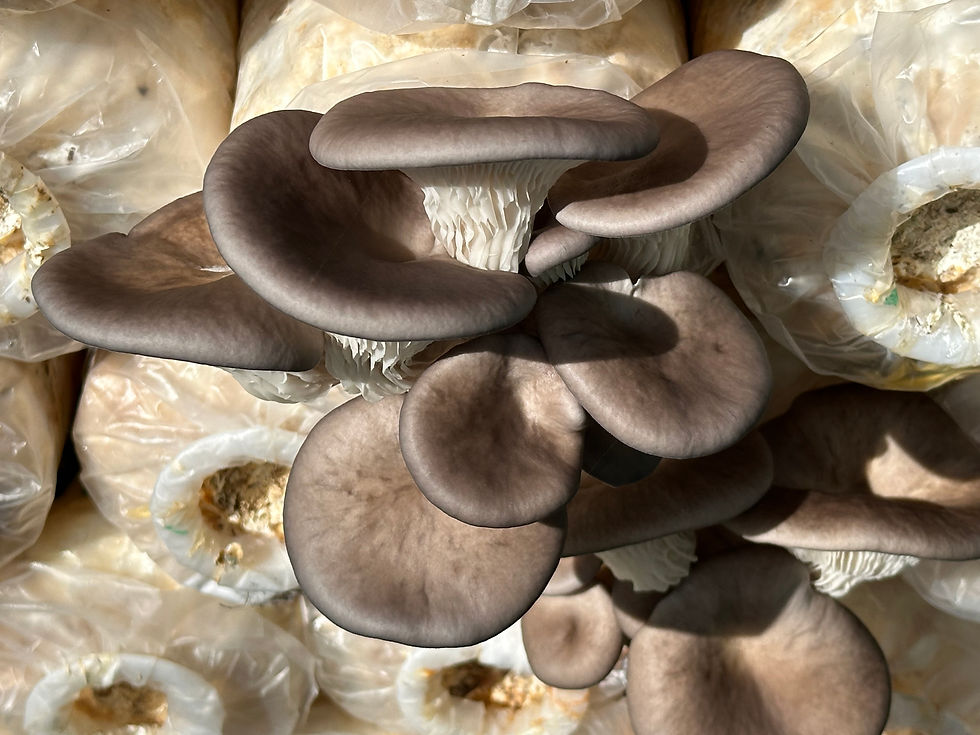
But what happens when those conditions don’t—or can’t—exist?
This article explores the difference between ideal fruiting parameters and the real-world
performance of HK35 in a semi-controlled, open-air growing environment in Ashburton,
KwaZulu-Natal—a region with high ambient humidity, strong heat variation, and no artificial
climate control. Drawing from direct experience, it highlights HK35’s remarkable resilience
and adaptability, showing how mushrooms thrive not just despite imperfect conditions, but
often because of them.
Ideal Fruiting Conditions: What the Literature Says
According to research and commercial recommendations, the following are considered
optimal for HK35 fruiting:
Parameter Ideal Range:
Temperature: 16°C – 21°C
Humidity: 85% – 95% RH
CO₂ Levels: < 800 ppm
Light: 500–1000 lux, indirect
Air Exchange: 4–8 exchanges/hour
These parameters assume a controlled indoor environment with humidifiers, HEPA-filtered
air, mist-free watering systems, and tightly regulated inputs. While such setups are achievable in high-tech grows, they’re costly and often unviable in regions with unpredictable climate and infrastructure constraints.
Real-World Conditions in KwaZulu-Natal: A Field-Based Account
In contrast, growing HK35 in an open, naturally ventilated structure with 80% shade netting,
a commercial misting system, and no active humidifiers or air filtration, presents a different
story—one filled with trial, adaptation, and observation.
Temperature Tolerance:
HK35 has fruited reliably in ambient temperatures of 30–33°C, and has even been observed fruiting under conditions approaching 40°C.
While yield and pinning frequency may decrease in extreme heat, mushroom quality and resilience remain surprisingly strong.
The assumption that fruiting only occurs in the 16–21°C range simply doesn’t hold in an open grow.
Humidity Realities:
Maintaining 70–80% humidity in an open system has proven sufficient and often preferable.
Attempts to raise humidity beyond 85% in an uncontrolled environment correlate with
increased contamination rates, not better yields.
Infrequent misting—e.g., 5 mins every 2 hours in cooler weather and 10 mins every hour during hot days—strikes a workable balance.
Hydration & Moisture Management:
Maintaining hydration within the block is more critical than sustaining constant ambient humidity.
Blocks that dry out in harsh heat have been successfully rehydrated with direct water input, often triggering vigorous pinning.
Direct misting on mushroom caps, typically discouraged in conventional literature, hasn’t caused degradation in HK35—in fact, mushrooms remain robust unless over-saturated.
Mushrooms Under Stress: The Case for Resilience
Perhaps most striking is HK35’s ability to hibernate during poor conditions and rebound
explosively when ambient moisture and temperature improve. This directly challenges the
notion that fruiting must follow a predictable cycle.
Real Observations:
Fruiting blocks kept in the grow space for 3.5 to 4 months have still produced strong flushes during periods of improved ambient humidity.
Some blocks produce early and frequently, others remain dormant for weeks—only to explode in growth during a weather shift.
The bioefficiency isn’t lost, it’s just delayed—time, not failure, is the key variable in unpredictable conditions.
Bag Opening Techniques & Contamination Control
Different approaches to bag opening have yielded varying results:
Fruiting from one side proves more stable in open-air environments—less contamination, better mist targeting.
Dual-sided fruiting increases risk of excess moisture retention and contamination, especially in dense columns.
Maintaining low contamination levels is critical. While some blocks inevitably succumb,
most survive and yield across multiple flushes when basic hygiene and ventilation are
managed.
Substrate and Variety Matters
Mushrooms don’t just respond to the air—they respond to what they’re growing on.
Many growers use straw-based substrate, which may suffice for hobbyist grow kits but offers lower nutritional density and limited fruiting potential.
Blocks made with complex, nutrient-rich substrates support HK35’s long-term production capacity, allowing for up to 4 or 5 flushes over 3–4 months.
Mushrooms draw from the energy stored in the block when conditions are right, regardless of when those conditions arrive.
Life Finds a Way: Beyond Fixed Variables
The conventional model of mushroom cultivation assumes fixed environmental variables,
allowing predictable planning and optimization. But in the real world—especially in natural
or semi-controlled environments—nature is anything but predictable.
Key Insight:
Mushrooms, especially HK35, are not just reactive—they are adaptive.
They respond dynamically to fluctuating humidity, air movement, and heat, often producing their best mushrooms under “suboptimal” conditions.
Soft, watery stems may result from excessive water uptake, while cooler, drier nights yield firmer, meatier mushrooms.
CO₂ and Airflow Observations
Inadequate airflow and high CO₂ levels lead to long-stemmed, leggy mushrooms.
Constant ambient air exchange (even unfiltered) in an open-air rope-column system prevents CO₂ buildup better than sealed environments.
Mushrooms do not require sterile perfection—they require balance and adaptability.
Final Thoughts:
A Different Kind of Optimum
The story of HK35’s success in Ashburton is not just one of adaptation—it’s a redefinition of what “optimal” really means.
In theory, optimal conditions are fixed, precise, and engineered. In practice, especially in climates like KwaZulu-Natal, they are fluid, seasonal, and circumstantial.
Key Takeaways:
✔ HK35 is resilient, adaptable, and well-suited to variable climates.
✔ 70–80% humidity, natural ventilation, and ambient misting can yield outstanding results.
✔ Bioefficiency is a marathon, not a sprint—blocks that seem spent may surprise you months later.
✔ Natural conditions create stronger mushrooms, not weaker ones.
✔ Life finds a way—and in the case of HK35, it thrives in the challenge.


Comments